strictlyseahorseinnl
ZeewaterForum gebruiker
Greetings from Amsterdam,
Sorry for the English. I just wanted to post about my experience with H. zosterae. I have 34 of them right now. I think my successes with them are due to the fact that I listen & took advice from the people on www.seahorse.org & www.syngnathid.org.
Listed below are some of the things I learned & resources that I use to buy the items from.
Tank Size: Is a Superfish Aqua Qube 40 with a Sera L 300 sponge filter with a mini 150liter per hour powerhead on it. I use the spraybar attachment that came with the tank. I angled the spraybar towards the surface. I also have a Mini Oxydator for extra oxygen in the tank. Speaking only for myself, I feel a minimum size should be around 20liter. I always ran into problems when I had a smaller size tank with temp fluctuations, ph swings & salinity. Plus if you are new to keeping the H. zosterae, the extra volume will help you out if you overfeed or forget to maintain the salinity.
Temp & Salinity: Temp should range between 21.5 till 23.5 and a salinity of 1.020 till 1.022 will suit them nicely.
Decoration & Gravel: I use Indo Black sand from Caribsea, plastic plants, macro algae’s & dry base rock that I cycled using the ammonia method. With live rock, you can introduce hydroids or aiptasia, nuisance algae, crabs, mantis shrimp and so on if you are not careful. I learned this the hard way a few years back and lost 6 of them. If you choose to use live rock, PLEASE quarantine them in a separate tank and see what developed on it. (Just look up posting on people who didn’t quarantine their live rocks to see the problems they have with it.)
Tankmates & Cleanup Crew: I have stomatella snails, mini stars, mini brittle stars, very small bristle worms, tisbe, Nitokra lacustris, peppermint shrimp & mysis in with them. You could use nassarius snail, mini hermit crabs & peppermint shrimp at your own risk. Some people like them & other people do not. Just keep an eye out for them.
Diet: It is very important that you vary their diet. Since I changed their diet to this method, I am having more active H. zosterae. I feed them baby brine shrimp/artemia up to 4 day old enriched brine/artemia, tisbe, nitokra lacustris, moina salina, tonsa & mysis. Here is how I culture them.
Brine shrimp/Artemia: I use a Hatcher for the brine/artemia. Once they hatch, I place them in two 1.5liter bottles with a mixture of nanno & iso. After they are 24 hours old, I enrich them with one of the following product, AlgaMac-3050, NatuRose, Spirulina Powder & HUFA. I do this until they are 5days old, after that they are fed to the mysis.
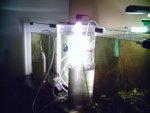
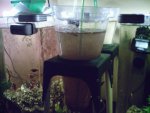
I use the vases because I ran out of room. You can use whatever containers suit you.
Tisbe: Are cultured in a 6 liter vase with greenwater with an airflow rate of two to three bubbles per second. I feed them1 -2 pieces of mysis just before I turn off the lights. If it is still there in the morning that is ok. When you turn on the lights in the morning & it is gone, add one extra piece to mysis to the nightly feeding. Increase accordingly. I harvest them weekly & put them in with the H. zosterae or to feed them to my H. reidi fry’s.
Nitokra lacustris: Are cultured in a 6 liter vase with greenwater with an airflow rate of two to three bubbles per second. I feed them 1 -2 pieces of flake just before I turn off the lights. If it is still there in the morning that is ok. When you turn on the lights in the morning & it is gone, add one extra piece flake to the nightly feeding. Increase accordingly. I harvest them weekly & put them in with the H. zosterae or to feed them to my H. reidi fry’s.
Tonsa: Are cultured in a 6 liter vase with a mixture of iso & nanno greenwater with an airflow rate of two to three bubbles per second. They need a light on them to keep the water green & for them to eat. When the water clears, add more greenwater. Also when you vacuum the bottom during a WC, put that gunk into a 1.5liter bottle. Within a week, the eggs should hatch out.
Moina salina: Are cultured in a 6 liter vase with a mixture of iso & nanno greenwater with an airflow rate of two to three bubbles per second. They need a light on them to keep the water green & for them to eat. When the water clears, add more greenwater. Also when you vacuum the bottom during a WC, put that gunk into a 1.5liter bottle. Within a week, the eggs should hatch out.
With the tonsa & moina, I strain then thru a fine mesh and feed them out to the H. zosterae.
The tisbe & nitokra can be placed next to them to share the light. They normally come out in the dark. Provide them with some LARGE PORES sponges to live in.
Mysis: The live mysis themselves serves as part of the cleanup crew and in return the mysis nauplii are a great food source for the H. zosterae. Dan Underwood from www.seahorsesource.com started adding the mysis in with his breeding stock. He is reporting that the H. zosterae actively hunt down the new born mysis & that the males are giving birth to bigger litters. (See this tread Live Mysids With Dwarfs)
PLEASE NOTE: I buy the live mysis for my 6 H. reidi & 1 H. comes. I keep the mysis in the 40liter bare bottom tank with a sponge filter with a mini power & an airline set at 10 to 15 bubbles a second. I rinse the sponge filter weekly. (It is SO FULL of gunk.) when I do a 25% water change.
To get the mysis ready for the H. zosterae tank, this is what I do: When you buy them from the store, the salinity is around 1.004 to 1.012. You need to slowly adjust it up to 1.020/1.022 level of saltwater. I do this in a separate container. It takes me three to four days to adjust them. I add nanno & iso at a rate of 10% to their weekly 25% water changes. I rinse the sponge filter weekly. (It is SO FULL of gunk.)
I feed both tanks any of the following items. Flake food, freeze dry cyclopeeze, Reef-bugs, bbs, pellet food, Formula One & Two frozen/flake, Vita-chem soaked freeze dry food, algamac-3050, naturose, spirulina powder and of course mysis. If I have agar on hand, I mixed all the dry ingredients in a mortar & pestle along with garlic & vita-chem to make my own food.
Once the Mysis are in with the H. zosterae, they will eat the leftover & dead brine/artemia. They do a very good job of keeping the tank nice & clean. I have between 50 to 75 mysis in the tank with them at the moement.
Peppermint Shrimp: They serve the same purpose as the mysis. Be aware that they could attack the H. zosterae if they are NOT THE TRUE PEPPERMINT SHRIMP. It is up to you to make sure that you are getting the true peppermint.
Pest: Hydroids or aiptasia are deadly to the H. zosterae. Please consult this forum or the other two forums on how to deal with them
Problems with my set-up: Since I do not have a protein skimmer on the tank, I develop an oily slick on the surface on the water. I remove this film with cling wrap/vershoudfolie. I turn off the powerhead and lay a piece of the wrap on the surface. The oily slick is attracted to the cling wrap. Repeat until it clears. Another problem I have is that some of the mysis jump out of the tank or they land on the underside of the glass top. This is due to the gap surrounding the tank.
Water changes & daily chores: I do a 25% water change weekly on the tank. The replacement water is around 20% greenwater & 80% saltwater. I spend around 45mintue to an hour a day just for the H. zosterae. I find it very relaxing taking care of them. The greenwater is to feed the tonsa & moina I always try to keep in the tank. I keep only the front panel clear & let the algae grow on the other panels. This is eaten by the stomatella snails, mysis & copepods.
Prices & Sources: I have been quoted €125.00 to €155.00 each in The Netherlands. I bought some from Helen @ www.simplyseahorses.co.uk for 65.00 pounds each plus 40.00 pounds shipping. I ordered 10 of them from her. Due to a freak accident, I lost two of them. Helen gave me credit right away on them. The second group I bought the stock from a private person. I pay €75.00 each for them. Helen just received 100 with the C.I.T.E.S. Permit. Chances are if you buy them from a store here, they came from Helen. The easiest way to find out is to ask to see the C.I.T.E.S. Permit.
Also when the weather warms up, I like to share my pod cultures with people. I do it on the PAY IT FORWARD SYSTEM. You only have to pay for the box & shipping. The pod starter cultures you get for free. When you find that you have more than you need, you past it on to the next person for free. You are allowed to ask for the cost of the box & shipping, but you are not allowed to profit from it. It is bad karma to ask for money on something you got for free.
Lastly, NONE of my H. zosterae is for sale at the moement. I am willing to trade with other H. zosterae owner to increase my bloodline. Right now I have USA/UK, German & Dutch bloodlines. I am working on getting some Swedish bloodline.
In conclusion, I just wanted to share my experiences with these wonderful creatures. Since they are so rare & hard to come by in Europe, we need to help each other out.
Sincerely,
Tim
Reading Resources: www.seafish.org File # SR487.pdf
http://seahorse.fisheries.ubc.ca/Documents/Books/Syngnathid_Husbandry_Manual2005.pdf
Copepod Culture
 I have two more males due within the next few days. I had nine new babies last week. As of today, they are still alive. They are really active little hunters.
 Nice write up, and thanks for sharing.