Wat is er Nieuw?
Zeewaterforum.info

U bezoekt ons forum als gast, wij zouden het leuk vinden als u zich registreert en aktief mee discussieert in de verschillende topics.

Varying the diet of H. Zosterae & setup.

22/03/2010

Came come to 20 more newborns today. I will be spliting up the group soon into two tank. I am planning a third tank for them by June.

Tim
 
Update: 19/03/2010

I placed an order for enrichment products & two more hatchers for Dan U. Heard some very good things about his new enrichment products. I will feed one tank with the enrichment & the other tank the way I do it now. I will report about it monthly to see if there is a difference or not.

The second tank is now filled up with fresh salt water & the gravel. The spongefiler & three small pieces of dry base rock is in a bucket being dosed with ammonia & starter culture. If all goes well, half will go into the tank in 6-8 weeks time.

I am slowly gathering equipment for a third tank. I need to do a rethink on this one. I want to try something different with it.
 
22/03/2010

Just came home to around 20 babies.
2thumbsup.gif
Also I still have the runt. I haven't seen him in awhile, so I thought he didn't make. Well! He is still around. Need to take a pic of him.
 
Update: 24/03/2010

The weather is starting to warm up over here. So I started one of my outside cultures. I bought one of these: http://www.brouwmarkt.nl/catalog/gis...ter-p-343.html It is 60 liter in size. I added 20 liters of bleached/declor tank water with 2 liter of nanno. Over the next week or so I will add more water to it & add 2 liters of my tonsa culture to it.

If all goes well, I will start one for the monia, tisbe, gammarus & brine/artemia growout.
progress.gif
 
Update: 31/03/2010

The outdoor culture suffered a set back. We had a cold snap here last week & I think it wiped out the culture.The water is just barely tinted green. I will leave it alone and see what happens with it.

The second tank is cycling away nicely. I will be adding the copepods to it sometime next week, followed by the mysis a week later.

Lastly, I bought a fish breeding trap that looks like a HOB filter. It holds 1.2liter of water & you run it with an airpump. It pumps the water from the tank into the trap & spills back into the tank. The slits on the bottom are very tiny, but I might put a piece of sponge on it. I was thinking of using it in the following ways:

1: I might house a pair of my peppermint shrimp in it. When they reproduce, their young will enter the tank & feed the H. zosterae & mysis.
2: Algae scrubber. I can place some Ulva or chateo in it.
3: Copepods. I can place my tisbe & nitokra lacustris in it. It is a safe place for them to reproduce & spill into the tank.

???Copepods???. I have some copepods in my H. reidi that swirls just above the gravel. I remove some to culture in a 6liter vase. So far they are reproducing. I just do not know what the are eating. I feed them with the Hail Mary apporch. I feed them mysis, flake & greenwater. Try to ID them off of http://www.marinebreeder.org but there is one that it might be? When I have the time, I will put them in different containers & feed them a mono diet. They are a hit with the H. zosterae though, so I will keep trying.

Tim
 
Update 20/04/2010

A bunch of the mysis gave birth today. It is a feeding bonanza for the H. zosterae. They really enjoy going into hunting mode when this happens.

I have been using a new enrichment product for about a week now. It is still early days, but I am very impress by it. I did away with the greenwater plus the old enrichment and now I only using saltwater & the new one. When the second tank is cycled, I will feed one tank the old way & one tank the new way and see if there is any difference.

I also spilt a small portion of my tonsa & my monia into three cola bottles. One is with greenwater only, one with greenwater & enrichment and the last one with enrichment only. I will wait 6 to 8 weeks & see what happens.

I am always looking for a way to improve my filtration for their tank. I use this on my H. comes & H. reidi tanks: http://www.aquatics-warehouse.co.uk/acatalog/AquaEL_500_filter_UV.html I think I can hook up a Sera Sponge in place of the cartridge & place a spray bar to reduce the flow to 4 to 5 times the turnover rate.

Lastly, I am getting my DREAM tank mate for the H. zosterae tank. Halocaridina rubra AKA Hawaiian Red Lava Shrimp, they make a great cleanup crew eating the algae in the tank. Plus due to their size, the H. zosterae will EAT them given the chance. For me it is not a problem that they do it. But for someone else, it is a very pricy meal. They do best it a mature system with a growth of algae on the rocks. They tend to hide at first, until they feel safe. The salinity of 1.019 to 1.022 suits them nicely. In fact they can go from near freshwater to hyper salinity in the wild.

An added bonus is that they leave the H. zosterae alone.

When I had them before, they didn’t like the tank with non-saltwater sand in it. I don’t think they like the buffer I needed to put into the tank to raise the PH. When I switched to Carbribsea Indo-black sand, it solved the problem for me. Here is a link to see what they look like. http://www.google.nl/images?rlz=1T4GGLJ_en&q=hawaiian+red+shrimp&um=1&ie=UTF-8&source=univ&ei=_JTNS4fFIc-gOOHnuaUP&sa=X&oi=image_result_group&ct=title&resnum=11&ved=0CE0QsAQwCg

Kind Regards,

Tim

april zots 072..JPG
 
Update: 28/05/2010

The second tank is nearly there. It went through 2 weeks of a diatom bloom & now just getting a little bit of hair algae. The mysis & pods are doing very well in the tank at the moement. I will wait about 2 – 3 more weeks before I split the H. zosterae.


I have a Tunze Nano skimmer on order for the first tank. The last three skimmers I try on the tank weren’t to my liking. The first tank is getting very hard to keep clean with all the H. zosterae in them & the amount of food that is needed for them. I am starting to lose the battle with cyano bacteria. My filtration cannot handle the load anymore.

Skimmer 1: Nano Scum by RedSun. (Yes that is the name of it.) It is a boxy little skimmer that looks like one from TMC. There isn’t a control valve to adjust the amount of air entering the chamber. Produces millions of micro-bubbles with very little skimmate even with the flow valve adjusted, plus the pump needs a sponge around the opening of the intake. Way TO NOISY. The collection cup is very small.

Skimmer 2: A small Sera skimmer. Same problem as the first skimmer, though the Sera does have an air control valve on it. The slits on the pump are very big; I needed to cover it with a sponge filter. VERY noisy. The collection cup is very small.

Skimmer 3: A mini Air driven skimmer from Sander. This one did work pretty well. The problem was with the wooden airstone clogging up quickly & the large opening. It did a pretty good job in regards to little or no micro-bubbles. I just didn’t like it for the tank. The collection cup handles the skimmate nicely.

Skimmer 4: The Tunze Nano Skimmer 9002 I have one on my H. reidi. After taking it off the tank for cleaning, bleaching & vinegar soak to remove the coralline algae; I decided to try it on the H. zosterae tank. Since it was only a tryout, I covered the unit with a fine mesh bag. Within 10mins of running it, the skimmer was pulling a lot of skimmate out of the tank. After 24hours, the oversized collection cup was 20% full. Didn’t see any Frys getting stuck by the slits or any excess food being removed to quickly in the skimmate. Didn’t see any effect with flow rate in the tank. It might be pricey & oversize, but I need to do something for the tank. I will post more on it once I get the new one in.
Here is a link for more info on it.
http://www.tunze.com/149.html?&L=1&C=NL&user_tunzeprod_pi1[predid]=-infoxunter050

I am now on the 6th week of the new enrichment. And I do have to tell you that I like it very much. I find that the brine shrimp are living longer & that I am having an increase in the numbers of births & the numbers of each birth. I sent some to a Germany for Angi to try out. Since I am the one selling it, I don’t want anyone to think I am hyping it. I need to work out a few kinks on how I am doing it & I shall post that soon.

One thing I notice is that I have been losing a quarter to a third of an inch of water daily due to evaporation. I have auto topoff on the other tank, but not the H. zosterae tank. To solve this problem I keep them at 1.019 at the highest level of the tank. Every day I slow drip freshwater back to that level. I can only speak for myself, but I noticed no ill effect from doing this. This is fresh filtered water & not straight from the tap water.

Lastly I have been hatching, sterilizing, raising & enriching the brine a little bit differently. I will post more about it on the next update.

Thank you for taking the time to read this.

Kind Regards,

Tim
 
Dan’s enrichment is nothing more than what I have posted using. The only difference is he blend/mixed everything together with more things added to it. All of the ingredients are written on the package.

When I first got the H. zosterae, I was using the liquid products & enrichments designed for the short term use. Almost everything I used is design to get larval fish past the stage where they need to be fed rotifers & brine. Since H. zosterae need to be fed brine among other things, for the long term, I just needed to know more about what I was feeding them.


Both of these companies are big in the aquaculture field. Most of their products are repackaged down to the hobbyist level by other sellers.
http://www.inve.com You might recognize some of their products. Selco & Super Selco being the most recognizable: I think some of their dry goods are mixed & repackage in liquid form.
http://www.aquafauna.com/Diets-AlgaMac-Protein%20Plus.htm Dan repackages & sells them in hobbyist size.

1: Liquid diets for the most part have a very short shelf life. Depending on the brand & ingredient used to make it. Anywhere from one month up to 8 months for what I have used. Plus I am leery of any product without an expiration date on it or a list of ingredients. If I cannot find the producer’s website, I don’t buy it.

2: Liquid Enrichment. I liked using Selco & Super Selco before. But I could not find any info on their website in regards to the shelf life of the products. While doing a Google search, I came across this site: http://www.artemia-international.com/default.asp?contentID=579#selco According to them:

Storage and Packaging: SELCO is available in 1-kg bottles, 9-bottles per case. SELCO has a shelf life of 12-months from the date of manufacture. Product should be stored in a cool, dark and dry environment (4-15 degrees Celsius). Once opened, product should be used within a one month and stored in a refrigeration type temperatures. Do not freeze.

After reading this, I did not know how long it sat in the store on the shelf before I bought it? I was not comfortable using it past the one month mark and it was too costly replacing it. Please don’t get me wrong, the product is great & everything. But it was designed to be used within a month of opening it.

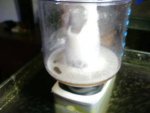
3: Dry Foods: I listed almost everything I used on the first post of this thread. I found it best to feed each one by itself. When I mixed it all together, I didn’t get the ratio correct & killed off a lot of the brine during the enrichment process. I find the dry food has a longer shelf life & easier to store. Since I was running low on the enrichment, I thought I would give Dan’s a try. It was getting good feedback on the org. So I thought why not, can’t hurt? All it is is the correct amount of the things I was buying plus some extra ingredients. Now I just measure what I need, put it in the blender for 2min, strained it & in it goes into the water. I still need to work a couple of things out with it. Otherwise I like the knock on effect it is having on my other fishes.

4: Phytoplankton: I still have a culture of iso & nanno going. I might try this: Live Tetraselmis 500ml next. I still use it to enrich the brine & to feed out to the pod cultures.

5: Brine Cysts: I bought two bags of the Siberian Eggs 80%/85% hatch rate in the blue bag in Germany last Oct in Duisburg while at a fish convention there. I store what I do not use in the freezer. I take out roughly a tablespoon every other day. Once I run out of it, I am thinking of trying this one. http://www.inve.com/INVE-Aquaculture/English/Products/Fish-hatcheries/live-feed/High-5/page.aspx/1194 Now I only need to find someone who will sell a can to me.
grin.gif


Before I was just hatching them out, but by the time they hatched, they smelt like sewer water & very cloudy. Now I rinsing them after 12hours & putting the back into the cleaned Hatcher with new water. It may a big difference in the smell & clarity of the water.

I also started handling the brine differently; I want to see if I can keep up with it before I do an update.

I am only posting this as my experiences with the products I have used. In no uncertain terms am I saying it is any better or worse than how other people are doing it. I really would like to hear about everyones methods of culturing the brine.

I feel with all the other food items I feed them; they are getting a diet that is good for them. Can I improve on it? I can keep trying.

Dan reports on average a H. zosterae owner will keep them alive for three months. Denise is correct to point out that they are very cheap & easily acquired in the states as wild caught or captive bred. So they tend to feed a mono diet & keep replacing them until they realize that brine alone is not a good long term diet for them.

Sorry to be long winded. But I really want the best for them & for you H. zosterae owner.

Thank you very much for taking the time to read this. I really appreciate you doing so.
 
breederbox 023..JPGbreederbox 024..JPGbreederbox 017..JPG

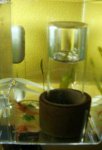
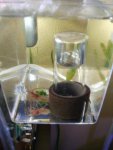
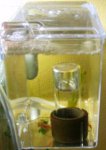
I added this little 1.2 liter HOB breeder trap to the H. zosterae tank about a 5 - 6 weeks ago. As you can see, I housed the mini-oxydator in there. Makes it very easy to remove for refilling. I also like the fact that I am adding extra 02 into the tank without putting an airline in the tank & I do not have to worry about salt creeps.

Since I have done this, the peppermint shrimp have given birth twice. Over a period of 12 hours or so, they flow into the tank. The H. zosterae really enjoy this added treat to their diet. What is not eaten by them is eaten by the mysis & the peppermint shrimp. Even the frys seens too eat them without a problem.

I just notice today that there is a tiny population of tibse & Nitokra lacustris growing in there. Another added bonus.

Tim
 
Update: 26/06/2010

Today was the fourth Dutch Marine Aquarium Event for 2010. It turned out to be a very very very lucky day for me. (Well very lucky times 6.)

The first order of business after the meet & greet was a short walk over to De Jong Marine Life a wholesale company. Everyone was going crazy of the fishes, corals & holding tanks. Whereas I was going crazy over their mysis holding tanks outside in the back. They had two large square tubs that you normally associated with koi fish just sitting out in the open. I spent a good 10 minutes just looking at the mysis swimming in the very green water & looking at the filtration for it. I had to explain to several people that this was FAR more interesting to me than a store full of fishes & corals. (Yes I did get weird looks from them.)

After about an hour or so, we walked back to the meeting place to listen to the talks given by Peter Schmiedel & Bruce Carlson.

Mr. Schmiedel talk was about keeping fishes together, how to sex certain kinds of fishes & his experiences with them.

Mr. Carlson talk was about how the coral reef can bounce back after a natural disaster, manmade disaster and how long it takes for the reef to bounce back. Since Mr. Carlson has study & surveys certain reef since the 70’s. He had lots of photographic evidence to show us the changes & growth of said reef.

During a break, I went to introduce myself to Mr. Schmiedel. I knew the name from somewhere before & Dan said that he was active on http://www.marinebreeder.org. (That is where I knew the name from.) I knew him more from his response & PM to this thread but on http://www.zeewaterforum.info a Dutch site. He wanted to sell me his H. zosterae, but I just didn’t have the money at that time. Since I knew he was a speaker at the event, I bought along Dan’s enrichment products to give to him. Well one thing lead to another & we agree to swap some of my dwarfs for his. Lucky #1.

The last function for the event was the raffle. I bought 30 tickets for 25.00 Euro’s at the last second. They had some great prices to give away. Well! It SURE way my lucky day. I won on the following numbers.

623, 624,228,634 & 638.

(AND YES there were some good natured comments & ribbing as I kept going up. But in my defense I didn’t pick the numbers & I didn’t know any of the people picking the numbers.)


I won:
Lucky# 2: A one year subscription to ONS Zeeaquarium a Dutch language magazine. I gave this to my friend since I already have a subscription. (I try to read this to improve my Dutch.)

Lucky# 3: A refractometer from D-D The Aquarium Solution.

Lucky# 4: A Pen type PH meter.

Lucky# 4: A Protein Skimmer by Aqua Complete in Rotterdam minus the pump. (This will come in handy for the breeding setup.)

Lucky# 6: Last but not less! A 30 liter Wave Box Vision Marine. A complete setup. This will housed the ones I will be trading with Peter for. (I love karma.) I always wanted one of these tanks. So I am very happy with it.

So all in all a very good day for me. I got a chance to meet a fellow dwarf owner in person, exchange ideas with each other, getting a fresh bloodline & winning the prizes. So a nice day all the way around.

Kind Regards,

Tim
 
Greetings from Amsterdam,

I notice that there has been over 1,000 veiwing on this thread. Nobody has a qustion? Also I am looking to trade some of my H. zosterae to increase my bloodline.

Sorry none are for sale yet. I have a long waiting list.

Kind Regards,

Tim
 
Hole in the wall .JPGHere is a quick pic of the dwarfs. Still need to work on my camera skill.

Update: 29/06/2010

I am getting on average a new batch every 4 to 5 days now. The second tank is just about ready. Only a touch of hair algae left.

I need to buy a stand for the Wave box tank. I will split it into a different thread when I have it set up. Any help that you can provide me with this tank is most helpful.

Tim
 
hi tim,
the tigerpods can be fed with ditritus, most of the time i see them spontanious in crashed artemia cultures eating all the garbage from the bottom of the holding tank. i am trying now to multiply the culture to use it as possible food source for mij baby horses in the third stage.

beware of these tigerpod? they attack small horse less than 10-12mm.
 
Laatst bewerkt:
I don't use them for that reason. Also I think you need to raise them at cooler temp for them to breed. At higher temps, they only produce one sex.
 
Update 16/07/2010

I just wanted to let everyone know that http://www.tropicalmarinefish.nl is now carrying the Two New Enrichment Products from Dan Underwood. Dan & his wife Abbie are the owners of www.seahorsesource.com.

Dans Feed - Artemia Enrichment - 50g bag

It is a blend of AlgaMac 3050, AlgaMac Protein Plus, Spirulina, Astaxanthin, Withania somnifera, and Mucuna pruriens. Well balance nutritionally with amino acids, vitamins, minerals, proteins, Omega 3 fatty acids with a very high DHA to EPA ratio. Also contains Ayurvedic herbs to increase resistance to disease without risk of antibiotic resistance, increase food conversion ratios, reduce stress, and in sexual mature seahorses, help induce spawning.


Dans Feed - Artemia Enrichment with Beta-Glucan - 50g bag

Like the regular Artemia Enrichment except it contains Beta-Glucan 1.3, 1.6 to further enhance the immune system. It is a blend of AlgaMac 3050, AlgaMac Protein Plus, Spirulina, Astaxanthin, Withania somnifera, Mucuna pruriens. Well balance nutritionally with amino acids, vitamins, minerals, proteins, Omega 3 fatty acids with a very high DHA to EPA ratio. Also contains Ayurvedic herbs to increase resistance to disease without risk of antibiotic resistance, increase food conversion ratios, reduce stress, and in sexual mature seahorses, help induce spawning.


Note: This product should be use for no longer than 6 weeks before giving the livestock a 2 week break. Use Dans - Artemia Enrichment for the 2 week rest period & repeat.

Shelf life, 50 grams, packaged in a re-sealable foil bag, approximately 1 year if kept dry & refrigerated or frozen once open.

To use:
Mix measured amount of enrichment (0.2 grams, approx 1/8 tsp per liter.) with freshwater in electric blender for 2 minutes (stick or handheld blender works exceptionally well) or until completely emulsified and particles are broken down. When blending is complete, strain through 50 micron mesh (Rotifer Sieve) to eliminate any foam.


Stock Solution: For convenient you can make a stock solution based on your weekly needs.

Heavy User: Add 3 teaspoon to one cup of water.

Medium User: 1 & half teaspoon to a half cup of water.

Light User: 1 teaspoon to a third of a cup of water.

Mix measured amount of enrichment along with the water in electric blender for 2 minutes (stick or handheld blender works exceptionally well) or until completely emulsified and particles are broken down. When blending is complete, strain through 50 micron mesh (Rotifer Sieve) to eliminate any foam. Store the solution in your refrigerator in a plastic bottle with nozzle for easy measurement. Add 2 teaspoon of enrichment solution per one liter of saltwater.


Transfer Artemia nauplii to an enrichment tank with clean, filtered seawater. Maximum density of Artemia should not exceed 100,000 nauplii per liter of water. Add the prepared enrichment mixture to the enrichment tank. Aerate enrichment tank vigorously so that oxygen levels exceed 4ppm during the 12 hours of enrichment. Harvest the enriched Artemia nauplii after 12 hours or for best results; repeat the enrichment process for another 12 hours.


50 gram will give you 250 liter at full strength, 500 liters at half strength & 1000 liters at quarter strength.

For H. zosterae: This is an excellent enrichment product for daily use. Use the Enrichment with Beta-Glucan for 6 weeks & the enrichment without it for two weeks. Repeat the cycle.

For Breeder: Great to get the fish into spawning condition, during the weaning & growout stages of your fish.

Adult Brine/Artemia: Feed/enrich the brine/artemia several hours before feeding it to your fish.

Rotifers: Can be used to culture them also.

Copepods: Great food/enrichment source along with plankton for A.tonsa or Monia Salina.

Gutload Mysis & Ghost shrimp: When fed the enriched brine/artemia, the shrimp will deliver all the benefits’ to your seahorses and other fishes.

One gram = Roughly ½ a teaspoon.
Hatch Rate
Nauplii per gram
90%
250,000
85%
240,000
80%
230,000
70%
210,000
65%
190,000
60%
170,000


Just wanted to let you know that I have been using the enrichment products going on five months now and I am very happy with the results I have been having.

Here are some helpful hints to make it easier for you to use:

1/8 of a teaspoon per 100,000 NBBS per one liter.

One gram = Roughly ½ a teaspoon.
Hatch Rate Nauplii per gram
90% +/- 250,000
85% +/- 240,000
80% +/- 230,000
70% +/- 210,000
65% +/- 190,000
60% +/- 170,000

The 1/8 teaspoon per liter is for the WHOLE liter only. For example: I have 300,000 NBBS I need to enrich. Base on the direction on the package, I need to use 3 x 1/8 of a teaspoon. I add the amount needed to the blender with about a cup of water, strain this into a container holding 3 liter of saltwater with the 300.000 NBBS. Repeat the process if I need to re-enrich in 12 hours. But if I use say 1 liter of it, then I repeat the process @ 2 x 1/8 of a teaspoon.

Or with the stock solution: I use 2 teaspoon per liter. So that will be 6 teaspoon of the stock to enrich the 300.000 NBBS.


Airflow: Make sure that the air rate/flow is at a medium boil or when you can no longer count the bubbles. You really need to keep the 02 very high.

Lights: I have them in daylight during the day & I have the lights from my plankton reactor on during the night. This gives them enough light to keep on eating.

Enrichment container: I use a 5 liter plastic bottle to enrich with. Base on your needs, you can use a cola bottle, an inverted cola bottle, the cone Hatcher or any plastic tub. Anything where the enriched NBBS can swirl and be kept in solution.

Tim

progress.gif
 
Greetings from Amsterdam,

I install the Tunze 9002:
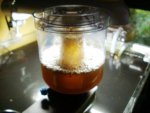
Pic 1: this is what it looks like as of 4/8/2010
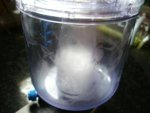
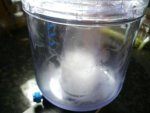
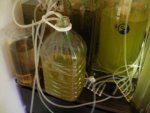
Pic 2:The second pic is one of the container I use to enrich the artemia with. Behind it is the mysis tank & to the right is the Plankton Reactor. During the day there is enough light for the artemia to keep feeding. At night, I turn on the reactor light so the artemia can keep feeding through the night.
Pic 3: Shows the mesh bag I put over the skimmer.
Pic 4 : Shows the skimmer on the first day which was on 25/7/2010 .

This is suppose to be the newer model with a ***slient*** pump. But is sounds like the other one I have. I am waiting for a replacing motor from the store & I will see how that goes. I bought the skimmer from http://www.tropicalmarinefish.nl

It is rather bulky & oversize for a 40 liter tank. But so far it is the best one of all the ones I used on this tank.

One thing that is strange is that it stopped foaming sometimes when I add the food into the tank. None of the other ones did that.

Haven't seen any of the H. zosterae stuck or trapped against the skimmer.

I do have to add a little bit more of the artemia with each feeding. Plus I notice that the H. zosterae snicking against the mesh.


Kind Regards,

Tim

PS, Don't ask me for pic of the H. zosterae. I cannot for the life of me take a clear pic of them.
Tunze Skimmer 022&.JPGTunze Skimmer 013&.JPGTunze Skimmer 020&.JPGTunze Skimmer 003&.JPG
 

Bijlagen

  • Tunze Skimmer 004&.JPG
    Tunze Skimmer 004&.JPG
    15,5 KB · Weergaven: 5
Back
Bovenaan