
greenbee
Senior Forumlid
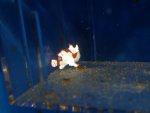
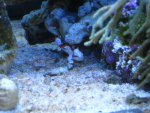
Ik weet niet of er verschil is tussen de uritai en de durbanensis, op de stocklist van De Jong, waar Michael ze heeft gehaald, staat 'Rhynchocinetes durbanensis (uritai)' dus daar schieten we ook niet veel mee op
R. durbanensis – Commonly known as the camelback shrimp, camel shrimp or dancing shrimp, R. durbanensis is from the Indo-Pacific and is NOT a cleaner shrimp. It may be advertised as the candy shrimp or, of course, the peppermint shrimp. Sometimes it is also called the hinged-beak shrimp, referring to its hinged beak or rostrum. R. durbanensis is patterned with red and white stripes (similar to some specimens of the species L. wurdemanni), but this ornamental shrimp is not reef tank compatible. R. durbanensis will eat aiptasia, but it may very well also pick at soft corals. This shrimp can be easily identified by the obvious “camel hump” on its back.
R. uritai – Commonly called the camel shrimp or camelback shrimp, like R. durbanensis, R. uritai is an Indo-Pacific shrimp and is also NOT cleaner shrimp. While very similar to R. durbanensis, R. uritai does not have the same pronounced beak and white streaking that R. durbanensis has. In addition, the coloration of R. uritai is somewhat duller. Further, R. uritai, unlike R. durbanensis, is currently known to be native only to Japan and Korea. Finally, the beak on R. durbanensis has 9-10 teeth along the top, whereas R. uritai only has 7-8 teeth. Like R. durbanensis, R. uritai will eat aiptasia but may very well pick at soft corals too.