[TABLE="width: 100%"]
<tbody>[TR]
[TD]
Persoonlijke informatie en bevindingen omtrent licht
Wavelength and Light
[/TD]
[/TR]
[TR]
[TD]By definition, wavelength is the distance between two similar points on a wave of energy while light is the energy from the sun, a lamp, etc, that makes us possible to see things. Visible light, light that is visible to the human eye, has a wavelength in a range from 380nm to 750nm approximately.[/TD]
[/TR]
[TR]
[TD]
[/TD]
[/TR]
[TR]
[TD][TABLE="width: 100%"]
<tbody>[TR]
[TD="width: 30%"][TABLE="width: 100%"]
<tbody>[TR]
[TD="width: 40%"]
Color[/TD]
[TD="width: 60%"]
Wavelength[/TD]
[/TR]
[TR]
[TD]
Violet[/TD]
[TD]380–450 nm[/TD]
[/TR]
[TR]
[TD]
Blue[/TD]
[TD]450-495 nm[/TD]
[/TR]
[TR]
[TD]
Green[/TD]
[TD]495-570 nm[/TD]
[/TR]
[TR]
[TD]
Yellow[/TD]
[TD]570-590 nm[/TD]
[/TR]
[TR]
[TD]
Orange[/TD]
[TD]590-620 nm[/TD]
[/TR]
[TR]
[TD]
Red[/TD]
[TD]620-750 nm[/TD]
[/TR]
</tbody>[/TABLE]
[/TD]
[TD="width: 70%"]White light can be dispersed into the above visible spectrum, which contains many colors in different wavelengths. The spectrum is continuous, with no clear boundaries between one color and the next. We can just specify the color ranges by approximation as had in the table on the left.
This spectrum extends on both sides to become a complete electromagnetic spectrum, containing also light that is not visible to us as well. Below 380nm, it comes immediately the ultraviolet, while above 750nm, it is the infrared.[/TD]
[/TR]
</tbody>[/TABLE]
[/TD]
[/TR]
</tbody>[/TABLE]
Wavelengths for Corals [TABLE="width: 100%"]
<tbody>[TR]
[TD="width: 15%"]
Wavelength[/TD]
[TD="width: 20%"]
Color[/TD]
[TD="width: 6%"]
OK?[/TD]
[TD="width: 59%"]
Application[/TD]
[/TR]
[TR]
[TD]Below-400nm[/TD]
[TD]Ultraviolet to Violet[/TD]
[TD]△[/TD]
[TD]Wavelengths below 400nm have excessive energy and can damage tissues. However, some corals produce colored pigments (blue, purple, pink) in their zooxanthellae cells for protection from the UV light.[/TD]
[/TR]
[TR]
[TD]400-500 nm[/TD]
[TD]Violet to Blue[/TD]
[TD]○[/TD]
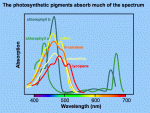
[TD]Wavelengths between 400nm and 480nm are the most important ones for photosynthesis of the brown algae in corals.[/TD]
[/TR]
[TR]
[TD]500-600 nm[/TD]
[TD]Green to Yellow[/TD]
[TD]△[/TD]
[TD]In most cases, wavelengths from 500nm to 600nm lower the efficiency of photosynthesis. But some corals may still need them.[/TD]
[/TR]
[TR]
[TD]600-680 nm[/TD]
[TD]Orange to Red[/TD]
[TD]△[/TD]
[TD]Wavelengths between 600nm and 660nm are the most important ones for photosynthesis. However, they are easily absorbed by ocean water and therefore suitable for some corals only.[/TD]
[/TR]
[TR]
[TD]Above 700nm[/TD]
[TD]Red to Infrared[/TD]
[TD]×[/TD]
[TD]Wavelengths above 700nm carry to little energy and do not effectively simulate photosynthesis.[/TD]
[/TR]
</tbody>[/TABLE]
Note: Red light will only penetrate natural water at a depth of 1-5 meters. Most corals we own live between 1-20 meters. Corals that are exposed to too much red light will turn brown and eventually ejecting there zoo-x.
Note:
http://link.springer.com/article/10....LI=true#page-1
Note:
http://www.advancedaquarist.com/2009/5/aafeature/
Note:
http://www.advancedaquarist.com/2003/11/aafeature
Note:
http://www.advancedaquarist.com/2008/12/aafeature1
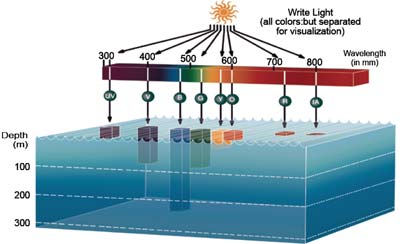
This diagram shows the depth that light will penetrate in clear ocean water. Because red light is absorbed strongly, it has the shallowest penetration depth, and blue light has the deepest penetration depth
Fluorescent Pigment by lightning
In this article, we see that red light apparently fails to promote coral coloration as efficiently as either green or blue bandwidths. Everything above 620nm (red) has little to no use.
http://www.advancedaquarist.com/2009/1/aafeature1
http://www-personal.usyd.edu.au/~cox/pdfs/nat_preprint.pdf
Green Light and Corals
An overlooked aspect of reefkeeping is the effect of green light on corals. Green light can produce similar effects as when blue light is used. Some corals have proteins that produce fluorescent light when in the presence of blue light, and some corals have proteins that produce fluorescent light when exposed to green light. In other words, by illuminating your aquarium with blue light and without green light, you may not be seeing all of the colors and patterns in your corals. Often a coral that looks rather drab in blue light will shine with striking colors when under green light.
http://jeb.biologists.org/content/206/22/4041.full
http://www.advancedaquarist.com/index_html/2012/7/lighting
http://theartfulamoeba.com/2011/05/05/hot-rhodopsin/
http://books.google.nl/books?id=vKMeiTu18p0C&pg=PA112&lpg=PA112&dq=zooplankton+light+500+nm&source=bl&ots=eErtm5cGr3&sig=IiCvNOGKIxrcfaFA3Y_I7pGl3F0&hl=nl&sa=X&ei=fyihUJrqGOmd0QXI0oDgCQ&ved=0CB8Q6AEwAA#v=onepage&q&f=false
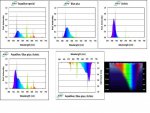
Vanwege het succesvoller koralen houden onder T5 heb ik hierboven een tekening geplaatst van de ATI T5 lampen. In de vierde grafiek heb de drie spectrums samengevoegd zodat er een totaal spectrum zichtbaar wordt indien deze lampen gecombineerd worden. De vijfde grafiek is grafiek vier gespiegeld en gecombineerd met de grafiek van spectrum van licht penetratie in zeewater.
http://www.danireef.com/2009/03/05/the-light/


 .... Ach ik probeer alleen maar wat centjes op de bank te houden door veel zelf te doen :biggrin:










 . De oorzaak is in grote waarschijnlijkheid dat ik het water van een gekocht koraal (soort van xenia) uit een winkel in mijn bak heb gedaan
  ... Voel me eigenlijk best dom, omdat ik normaliter andere mensen juist adviseer dit niet te doen
  .
.